Posts in Home Media
GUEST ESSAY: Determinism verses Free Will: The Mythic and Secular Architecture of "Minority Report"

By Truman Hood

Minority Report is a dystopian warning of a police-state, big brother-esque surveillance society that has experienced a complete destruction of free will. This central idea of the film is told not only through exposition throughout the film, but also by the built environment where the storytelling architecture assists in creating a narrative of a self-fulfilling prophesy. The built environment of Minority Report conveys how humans have abandoned the belief that their fates are determined by greater powers than themselves, such as gods or karma. Instead of mystic powers responsible for the repercussions of those actions, the contemporary worldview shifted.

Read More
GUEST ESSAY: Authority in Architecture: An In-Depth Look at "The Adjustment Bureau"

By Hannah Thayer

The concept of only being able to move a predetermined number of ways within buildings, and within life, is challenged in The Adjustment Bureau. The people in the adjustment bureau are able to defy what architecture is and how it rules us by traveling through space using only doors; they open a door and choose where it leads to. Architecture has no authority over them as they get to use buildings how they see fit and use them to their space-traveling advantage. The built environment can be very demanding and incredibly intimidating. This movie addresses the idea of what is out of our control and how far are we willing to go to get it, while using the built environment to emphasize just how small we really are in the grand scheme of things. 

Read More
GUEST ESSAY: "Cidade de Dues:" A Manipulated Reality of Favelas

By Omar Cardoza

In 2002, Cidade de Deus, otherwise known as City of God, was released in Brazil. It did not take too long before the film became internationally acclaimed, in fact this film was nominated for multiple Oscars although it did not win. The film’s narrative, filming techniques, and setting provide for a compelling argument that the whole story is in fact a true depiction of the favelas Brazil. Films and cinema can be a means to generate discourse between a reality presented to us through the screen and the actual reality of the world. This can cause changes not only to the individual but through enough exposure to a broader audience can cause changes at the societal level and “is extremely important and carries tremendous responsibility since believing that films can shape the collective imagination can (re)affirm or deny a preconception or even reinforce…”

Read More
GUEST ESSAY: Who I Am, Where Do I Come From: The Ontology Behind "Westworld" and the Life of Choice

By Shanle Lin

By the 17th century, when Galilei noticed that the earth goes around the sun instead of the opposite around. Many people were in shock. They couldn’t have believed that human wasn’t at the center of the universe. Generally, it is not the various great ideas that subvert the way of people thinking, but our ignorance of yesterday. People are afraid to accept the impact a brought by the solidified-mind revolution, although this is born with human nature. In the movie Westworld (1973), John Michael Crichton bravely used “technophobia” to express what may happen if robots made for hedonism or recreation purpose generate their own mind.

Read More
GUEST ESSAY: The Plague of Exile in "District 9"

By Steven DiGiorgi

After analyzing Neill Blomkamp’s District 9 (2009), the setting of the film capitalizes on the post-colonial setting in Johannesburg, South Africa. What we viewed in the film as a representation of South Africa’s past, through an alternative perspective that identified the oppressed African people as aliens, known as the ‘Prawns’. The isolated community of District 9 represents oppressed living conditions for the millions of people negatively affected during the Apartheid rule (1950-94) (Weaver). For half a century, the South African people had faced dehumanization and discrimination by xenophobic Europeans. The caricature of the European colony was portrayed as the private military, MNU. They followed a typical method of a dystopian society, where power was diverted from the people to the hands of the government.

Read More
GUEST ESSAY: Time-Transcending Architecture in "The Lake House"

By Tessa Cleary

“Home is where the heart is” is an expression used to portray the feeling that someone acquires in a building but is realistically used to describe the way they interact with the space around them. The house that was constructed in Alejandro Agresti’s The Lake House, is a prime example of how a building can be considered successful architecture but lacks the interconnectivity that a home needs with the dweller. Years ago, people would stay in their home almost the entirety of their life usually due to things like lack financial stability, inability to move or neighboring family ties. Now it seems as though it is very common to move from place to place throughout the span of one’s life. When someone moves around frequently, it makes the house they dwell in less special because of the lack of time spent in that place to create memories and connect with the space and the people who live in it.

Read More
GUEST ESSAY: Architecture as Character: “The Hateful Eight” Becomes Nine

By Jake Monroe

Architecture and cinema have formed a relationship through film progression thought the 20th and 21st centuries. This relationship has its roots theater extending beyond the silver screen. Often this relationship acts to create setting, to ground the characters and give them an environment to react to and use to their advantage. It is often used strategically by the filmmakers as a tool for conveying what they set out to tell. At times, however, in the film the architecture transcends the role of place and becomes an active participant in the story at hand. It acts and reacts to alter and progress the story. The Hateful Eight, directed by Quentin Tarantino, is a beautiful example of this kind of architecture in film. I will discuss how the cabin in the film transcends set to become an active character and ultimately have a sense of self.

Read More
GUEST ESSAY: The Beginning of ("Her")

By Patrick Marcel Donte Winston

An in-depth analysis of Spike Jonze's 2013 film Her, and its relation to progressing artificial intelligence and architecture. Specifically, I question the need of tech in our society and whether it is a benefit or danger to our societal norms. We see technology quickly becoming more advanced in the past 10 years, but will it become God-like? We see advanced technology as our main source of communication, transportation, living, and more. While being so connected to this tech-driven lifestyle, what if we lost control of technology and can't communicate with it?

Read More
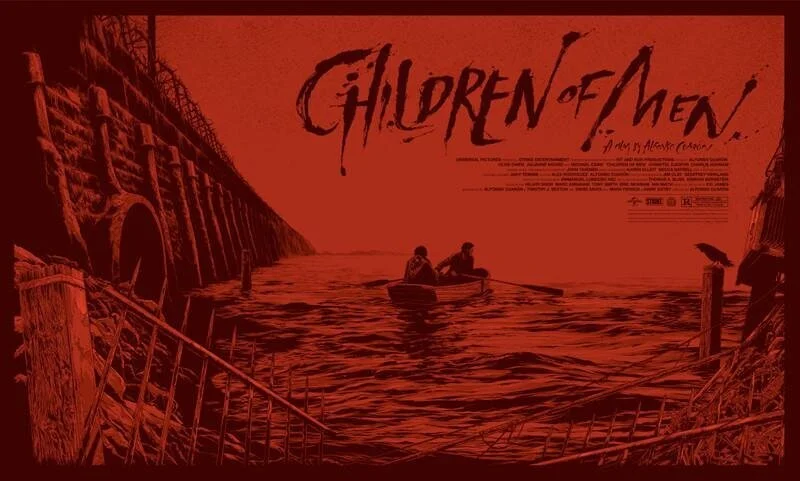
GUEST ESSAY: The Architecture of Hope and Desolation in "Children of Men"

By Jessica Ishizaka

Children of Men poses a future where infertility threatens the human race with extinction.  With the death of the youngest person in the world, many extreme groups have risen in order to gain control and take matters into their own hands.  Laws are put in place to detain and deport immigrants and to control the citizens of London. The director of the film, Alfonso Cuarón, creates a political atmosphere that is particularly ruthless as he paints the world in a shade of dread and grime.  The world and everything in it have been worn down and abused for 20 years, and no one has the ambition to replace or renovate anything since the extinction of the human race is near. 

Read More
REWIND REVIEW: Where'd You Go, Bernadette

Anyone who seeks to own this version of The Lion King is doing so with a “how did they do that?” curiosity. The technical brilliance is its biggest selling point. That interest is answered very well by this disc release. Unlike its Pixar and Marvel offerings, Disney compiled a legitimate look into this re-imaginings wholly revolutionary bells and whistles. This movie will look gorgeous on your high-end television at home.

Read More
MEDIA APPEARANCE: Guest on the "Feelin' Film" podcast for "The Peanut Butter Falcon"

Twice in a month! On the heels of their monumental three-part 200th episode special (covering the true Indiana Jones trilogy), I returned to the Feelin' Film Podcast to close out the 100s with an underrated and underseen gem that all three of us loved. For Episode #199, Patrick Hicks, Aaron White, and me discussed the high values and movie merits of The Peanut Butter Falcon starring Zack Gottshagen, Shia LeBeouf, and Dakota Johnson. Earning five-stars from all three of us, this road movie stands as one of our favorites from 2019 that we hopes gains in appreciation and acclaim with time.

Read More
COLUMN: Top 5 Movies to Get Inspired for Creative Essay Writing

Movies are among the best ever helpers when it comes to inspiration. Needless to say that when you are stuck with essay writing, it is better to watch an inspiring film about writers than to focus on procrastination, computer games, and social media. We don’t judge those activities — but if speaking about efficiency, watching movies is a good choice. Especially when those movies show writers, their struggle, good and bad decisions defining their career. Start with these five movies, and if it is not enough, storm on Netflix and find some more. However, from our experience, one film is enough for staying inspired for a period needed to write an essay.

Read More