Posts in Column
COLUMN: How to Brainstorm Film Ideas

So, you want to write a new screenplay, and looking around for some good ideas. But where to start with? What should you do first and how to nurture a movie you’ll be proud of? Birth of a concept might be tricky, indeed, but your creative searches can be easier if you know where to look for. Speaking frankly, ideas are hanging in the air, and all you have to do is to reach out and pick one. Think it sounds easier than done? Good for you, because we’ve done some homework for you, and are ready to provide you with tips and tricks on how to brainstorm few good film ideas. Here we go! Top four good advice tips for creating your future blockbuster!

Read More
GUEST ESSAY: Who I Am, Where Do I Come From: The Ontology Behind "Westworld" and the Life of Choice

By Shanle Lin

By the 17th century, when Galilei noticed that the earth goes around the sun instead of the opposite around. Many people were in shock. They couldn’t have believed that human wasn’t at the center of the universe. Generally, it is not the various great ideas that subvert the way of people thinking, but our ignorance of yesterday. People are afraid to accept the impact a brought by the solidified-mind revolution, although this is born with human nature. In the movie Westworld (1973), John Michael Crichton bravely used “technophobia” to express what may happen if robots made for hedonism or recreation purpose generate their own mind.

Read More
GUEST ESSAY: The Plague of Exile in "District 9"

By Steven DiGiorgi

After analyzing Neill Blomkamp’s District 9 (2009), the setting of the film capitalizes on the post-colonial setting in Johannesburg, South Africa. What we viewed in the film as a representation of South Africa’s past, through an alternative perspective that identified the oppressed African people as aliens, known as the ‘Prawns’. The isolated community of District 9 represents oppressed living conditions for the millions of people negatively affected during the Apartheid rule (1950-94) (Weaver). For half a century, the South African people had faced dehumanization and discrimination by xenophobic Europeans. The caricature of the European colony was portrayed as the private military, MNU. They followed a typical method of a dystopian society, where power was diverted from the people to the hands of the government.

Read More
GUEST ESSAY: Time-Transcending Architecture in "The Lake House"

By Tessa Cleary

“Home is where the heart is” is an expression used to portray the feeling that someone acquires in a building but is realistically used to describe the way they interact with the space around them. The house that was constructed in Alejandro Agresti’s The Lake House, is a prime example of how a building can be considered successful architecture but lacks the interconnectivity that a home needs with the dweller. Years ago, people would stay in their home almost the entirety of their life usually due to things like lack financial stability, inability to move or neighboring family ties. Now it seems as though it is very common to move from place to place throughout the span of one’s life. When someone moves around frequently, it makes the house they dwell in less special because of the lack of time spent in that place to create memories and connect with the space and the people who live in it.

Read More
GUEST ESSAY: Che’s Transformative Journey without a Motorcycle

By Gabriel Hernandez

An 8,000 km journey across South America from Argentina to Peru will change people's perspective on life, an experience that will change the way one sees injustices around the world. The viewer will get a grasp on the discrimination between the upper-class communities and the indigenous people across Latin America in 1952. The story of Ernesto "Che" Guevara and his friend Alberto Granado's journey through South America was not meant to portray Che Guevara as a hero by any means. I believe it was only meant to recall the trip that molded him through the basis of his memoir. He described himself as a transformed man once the journey was completed from what he saw, whom he had met, and his near-death experiences on the road.

Read More
GUEST ESSAY: Architecture and Animation with "Howl's Moving Castle"

By Terrance Steenman

To be honest, I never thought too heavily about architecture growing up. I imagine most people feel this way their entire lives. Sure, when we were children there were LEGOs or Lincoln Logs (if you were so fortunate as to have those toys), and with those toys one could build a space of imagination, but rarely do people make the connection that the lessons learned can be applied to the masonry, wood, steel or concrete that shape our daily lives. Constantly in the field of architecture, we are told to think back to a time when we did not have architectural eyes, and to instead view architecture from the lens of the ordinary person

Read More
GUEST ESSAY: Architecture as Character: “The Hateful Eight” Becomes Nine

By Jake Monroe

Architecture and cinema have formed a relationship through film progression thought the 20th and 21st centuries. This relationship has its roots theater extending beyond the silver screen. Often this relationship acts to create setting, to ground the characters and give them an environment to react to and use to their advantage. It is often used strategically by the filmmakers as a tool for conveying what they set out to tell. At times, however, in the film the architecture transcends the role of place and becomes an active participant in the story at hand. It acts and reacts to alter and progress the story. The Hateful Eight, directed by Quentin Tarantino, is a beautiful example of this kind of architecture in film. I will discuss how the cabin in the film transcends set to become an active character and ultimately have a sense of self.

Read More
GUEST ESSAY: California Dreaming in Concrete Forests of Hong Kong in "The Chungking Express"

by Ruohao Yan

Chungking Express, a 1994 movie about romantic and urban life in Hong Kong, depicts the glamour of the metropolitan life and social issues in Hong Kong. The film director, Wong Kar-Wai, describes two love stories between ordinary citizens. In the first romantic story, a police officer, went by the number “223” broke up with his girlfriend on April fool's day, but he was trying to salvage his relationship with her. A month later, he found that his girlfriend had a new love, so chose to give up and went to a bar to forget. He met a female drug dealer in the bar who was betrayed by her boyfriend. The two spent the night together. However, their relationship did not work out. In the second story, a police officer, went by the number “663”, had been in a depression for a long time due to his breakup with his girlfriend. The film not only highlights the beauty of Hong Kong, but also touches upon the dark side of society

Read More
GUEST ESSAY: The Beginning of ("Her")

By Patrick Marcel Donte Winston

An in-depth analysis of Spike Jonze's 2013 film Her, and its relation to progressing artificial intelligence and architecture. Specifically, I question the need of tech in our society and whether it is a benefit or danger to our societal norms. We see technology quickly becoming more advanced in the past 10 years, but will it become God-like? We see advanced technology as our main source of communication, transportation, living, and more. While being so connected to this tech-driven lifestyle, what if we lost control of technology and can't communicate with it?

Read More
GUEST ESSAY: The Pursuit in Deconstructing the Dream

By Ezekiel Nelson

In a setting where the ideal suburban life has manifested into its full form, far separate from urban pressures, individual lifestyles and attitudes begin to morph into something distinctively different than that of city living. Settling into a home and life vacant of shops, plazas, markets, and all other services and opportunities the urban fabric has to offer rids one of everyday meaningful experiences. The small section of the suburban world one occupies condenses and poorly simplifies life through a narrow view frame. In such a sterile setting, common distractions are sanitized and eradicated, along with environmental sensory stimulation. This may be beneficial for short periods of time, but environmental stimulation is also necessary for human existence and sense of identity.

Read More
GUEST ESSAY: A Fantastic City of Chocolate

By Asucena Alvarado

In the world, people are producing many films that make our lives more enjoyable, and with each film, we can learn, dream, see the impossible, and believe that anything is possible in life. Even though we know there are some things that are just fantasy, but movies help us to think that everything could happen. A good example of a fantasy story is Charlie and the Chocolate Factory, where we can see that be humble and kind can give you a reward, but in the real world, we know this is not always true. Here, I want to make a deep research about the film and how the capitalization, the utopian vs dystopian and the past vs present are reflected in this movie, and how it is related to architecture. 

Read More
GUEST ESSAY: The Architecture of Hope and Desolation in "Children of Men"

By Jessica Ishizaka

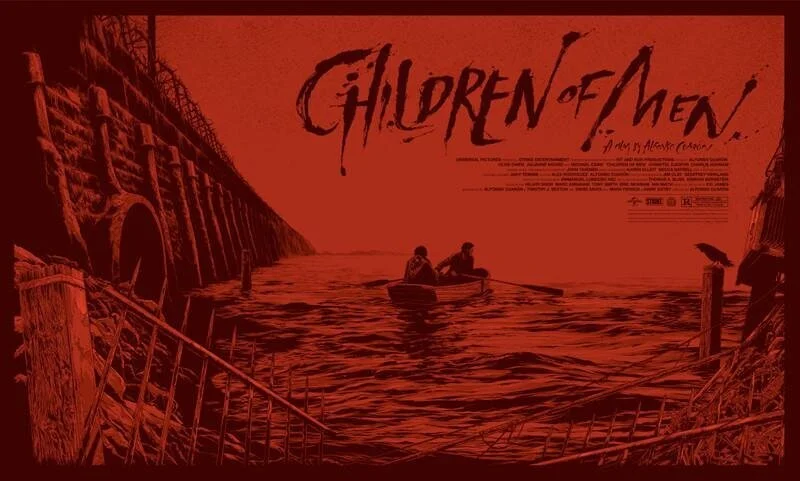
Children of Men poses a future where infertility threatens the human race with extinction.  With the death of the youngest person in the world, many extreme groups have risen in order to gain control and take matters into their own hands.  Laws are put in place to detain and deport immigrants and to control the citizens of London. The director of the film, Alfonso Cuarón, creates a political atmosphere that is particularly ruthless as he paints the world in a shade of dread and grime.  The world and everything in it have been worn down and abused for 20 years, and no one has the ambition to replace or renovate anything since the extinction of the human race is near. 

Read More