
Who Really Controls the Table in Poker Movies

The most revealing question in Molly’s Game is who gets to decide what happens around the table. Aaron Sorkin’s film follows Molly Bloom as she builds a place for herself among people accustomed to getting their own way. Jessica Chastain makes that ambition compelling. The uncomfortable part is watching how easily access, income, and influence become entangled.
Bloom’s own account gives that tension a concrete beginning. In her 2018 NPR interview, she recalled helping at a celebrity poker game and earning more in tips that night than she had earned in the preceding month. She then spent a year learning the game before running games herself. Eventually, she was also extending credit. An exciting opportunity had become a much more complicated responsibility.
That progression makes the film worth discussing beyond its famous names. It also offers a useful way to watch poker movies: pay attention to the decisions made before the cards arrive.
The invitation has a price of its own
An exclusive room gives a filmmaker an immediate source of tension. Someone controls the door. Someone wants to get through it. A seat can suggest acceptance, status, or the possibility of becoming a different person.
In Molly’s Game, the appeal of the room stretches beyond the money on the table. Bloom is building something that important people want to join. Her ability to organize that experience gives her influence, but it also makes other people’s approval valuable to her.
The distinction matters. Being wanted in a room does not necessarily mean that the room serves your interests. A film can make the invitation feel like a victory long before anyone has examined the conditions attached to it. That is an effective dramatic device, and a poor substitute for making your own decision.
Listen for who gets to explain the arrangement
Sorkin’s dialogue is well suited to a story about competing versions of events. A quick explanation can sound like command of the situation. A character who can describe the rules fluently may appear to control them.
For a viewer, there is pleasure in being carried along by that confidence. There is also value in pausing mentally to ask whose description you are accepting. Does the person explaining an arrangement benefit when everyone else agrees? Can another person question it without losing their place?
Bloom’s move from organizing games to extending credit is especially useful here. Those activities involve different responsibilities, even when they happen in the same room. Treating each new responsibility as merely another part of the original opportunity can obscure how much the arrangement has changed.
A good scene and a good decision need different information
A poker scene usually needs the audience to understand what a character wants and what could be lost. It does not need a complete explanation of the costs, procedures, or alternatives. A film that stopped to answer every practical question would soon lose its momentum.
The missing detail becomes a problem only when a viewer treats dramatic momentum as a model for real play. Imagine setting a hypothetical $50 entertainment limit, then buying in for another $50 because the evening suddenly feels important. The total commitment is now $100. The emotional reason for continuing does not change that arithmetic.
That example is deliberately ordinary. It has no spectacular comeback and no revelation about an opponent. Its usefulness lies in making the decision visible before a story about redemption or belonging takes over. The limit needs to mean something while the outcome is still unknown.
Give the unglamorous questions some screen time
If a film leaves you curious about playing, turn that curiosity into questions before turning it into a deposit. These are the details that a screenplay can reasonably leave outside the frame:
- What are the actual charges, and where are they explained in writing?
- What conditions apply to withdrawing money or using a promotional offer?
- Who handles a dispute, and what process can you check beforehand?
- What would make you stop, even if the room still felt exciting?
Independent reading can help organize that comparison. The poker-room reviews at PokerDealsHQ are one starting point for comparing rooms and their published offers. Use a review to identify questions, then check the room’s current terms yourself. An attractive description is not a reason to skip a condition you do not understand.
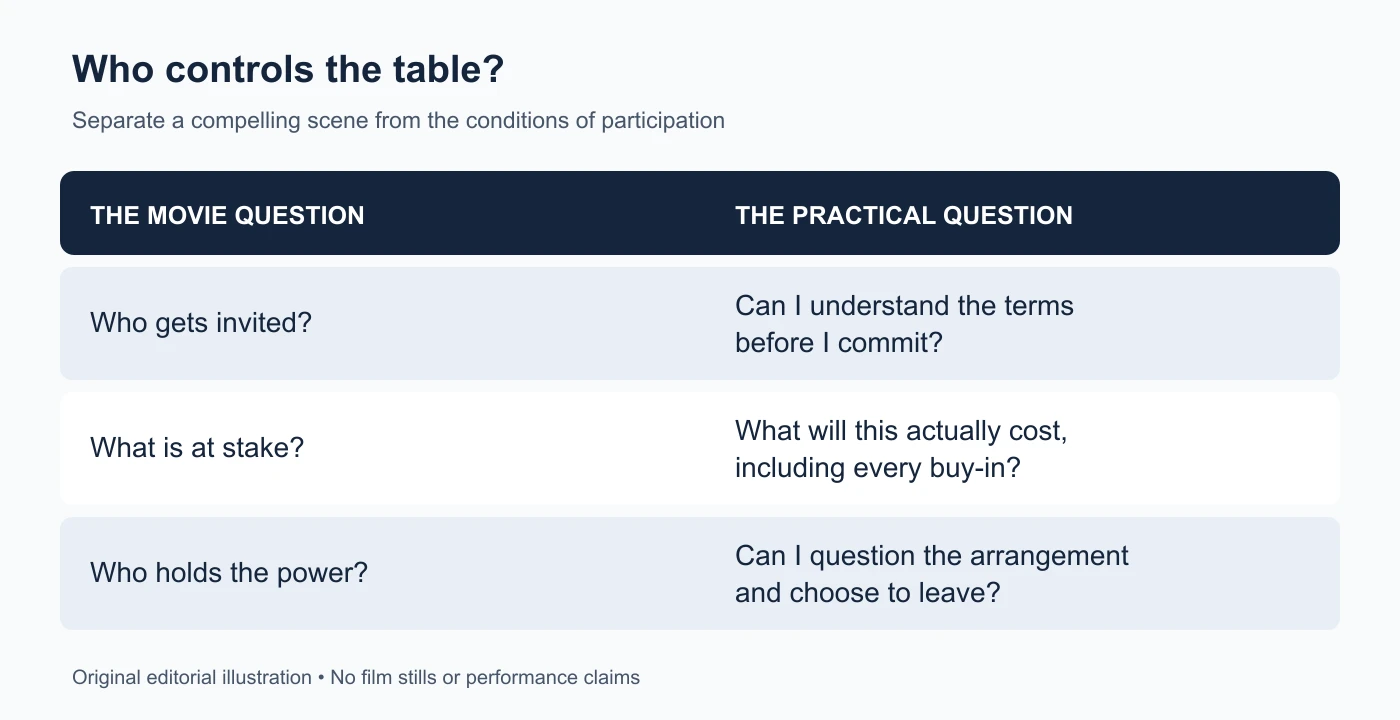
A way to separate the story’s appeal from the conditions of participation. Original illustration; no film stills or performance claims.
The freedom to leave is part of the story
The tension in Molly’s Game comes partly from the growing distance between being able to run a room and being able to control everything that happens in it. Chastain’s character can be capable, determined, and vulnerable to other people’s choices at the same time. That combination gives the film more substance than a simple celebration of nerve.
Watching for boundaries changes the questions a poker movie leaves behind. Instead of asking only whether someone will win, you start asking what they are being asked to accept, what their position depends on, and whether they can walk away. Those questions can make a scene more interesting. They can also make the choice to stay outside the game easier to respect.
