
What Hollywood's Tough Guys Teach Us About Jewelry as Armor
by Nancy Fernandez
The camera lingers on a hand. A ring catches the light. A chain shifts under a shirt. The film does not need to say the words because the metal already has.
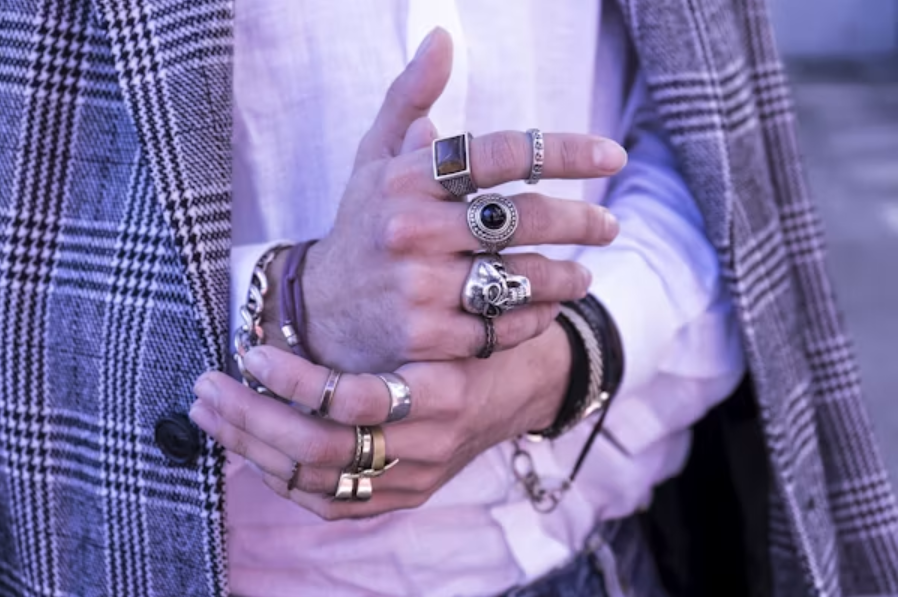
Hollywood has been quietly teaching the same lesson for sixty years. The jewelry on a tough guy is never a decoration. It is the character's history worn in plain sight. Each piece does a specific job in the story, and that job is usually different from the one the next piece is doing.
If the cinema lesson tracks for you, the chain is the cleanest place to start, which is why most men buy silver chain from Mcker online as the first anchor piece before layering on a ring, a cuff, or a pendant.
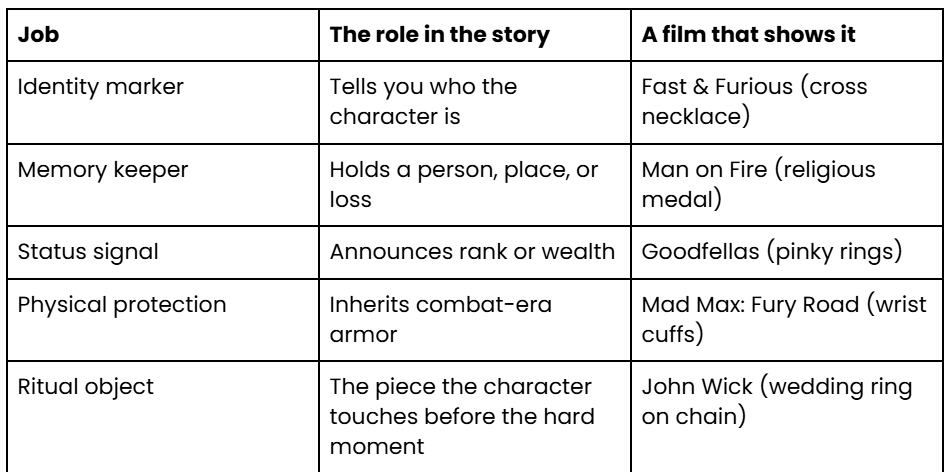
Below are the five jobs that metal does in the films where men get rough. Pick one or two, and the same trick starts working in your own wardrobe.
TL;DR
In tough-guy cinema, jewelry does five jobs. It marks identity, holds memory, signals status, protects the body, and gives the character something to touch before a hard moment. The five jobs translate directly into how a piece can sit in a real wardrobe. Pick pieces with weight and meaning, and the metal starts working before you say anything.
JOB ONE: THE IDENTITY MARKER
A piece of jewelry that says "this is who I am" sits at the center of more action films than any other category. Vin Diesel's Dominic Toretto in the Fast & Furious series wears a small silver cross on a slim chain in nearly every appearance from the first film forward. The cross was his father's. It stands for family, faith, and the line he never crosses. Don Shanahan's review of Fast and Furious 6 on Every Movie Has a Lesson tracks how the franchise leans on family as its load-bearing theme, and the cross is the steady visible reminder of it.
John Wick wears his wedding ring on a chain around his neck after his wife dies, and it doubles as an identity tag through every entry in the series. Liam Neeson's character in Taken keeps his wedding band on his finger as a quiet reminder of what he is still fighting for. Same pattern, three different franchises. One small piece of metal, kept close, telling you who the man is.
JOB TWO: THE MEMORY KEEPER
This job sits closer to a relic than a fashion choice. The piece is worn because of what it carries, not because of how it looks.
Mickey Rourke's character in The Wrestler keeps a small chain that ties him to the life he used to have. Denzel Washington in Man on Fire is shown holding a religious medal more than once, and the medal does the work of a hundred lines of backstory. The audience reads loss, regret, and a faith the character is trying to hold onto.
The cinematic version of the memory keeper is usually small and easy to grip. That is not an accident. Directors tend to choose pieces a character can fit inside a closed fist.
JOB THREE: THE STATUS SIGNAL
The mob film made the pinky ring famous. Goodfellas put one on Robert De Niro and another on Joe Pesci. Casino built whole scenes around the wedding ring and watch culture of Sam Rothstein. The Departed used small visual cues to mark rank inside a Boston crew.
The job here is loud and public. The ring announces position. The chain shows wealth. The watch tells anyone who is paying attention what the man is worth and who he runs with. None of this is subtle. It is not meant to be.
In real wardrobes, the dial gets turned down, but the same logic still works. A solid sterling silver pinky band sits closer to quiet confidence than a flashing sign, and it carries enough weight to read across a room without going full mob aesthetic.
JOB FOUR: PHYSICAL PROTECTION
The cuff is the oldest piece of jewelry in cinema because the line traces straight back to combat. Wrist guards in gladiator films, leather straps in the post-apocalyptic frame of the Mad Max series, knuckle armor in samurai stories. The piece was built to absorb impact. The look survived the function long after the function went away.
Tom Hardy's Max in Mad Max: Fury Road carries this lineage. The wrist hardware reads as part of the character before he opens his mouth. Anya Taylor-Joy continues the same visual language in Furiosa: A Mad Max Saga, where the bracelets and rings work as tools as much as accessories.
In real wardrobes, a heavy cuff or a thick-link bracelet inherits the same read. It says the wearer is not precious about the piece. That is most of the look.
JOB FIVE: THE RITUAL OBJECT
A piece of jewelry the character touches before a hard moment is doing work no other costume element can. It becomes a small prayer the audience watches happen.
The John Wick films are full of this. Don Shanahan's reviews of John Wick: Chapter 2 and John Wick: Chapter 3 - Parabellum keep circling back to the rituals that define the character. The wedding ring on a chain is the ritual object Wick reaches for before the worst nights.
Fight Club flips the same idea. Tyler Durden's stripped-down look, with one or two clean pieces of metal, signals a character who has rejected the noise. The minimalism is its own ritual.
The piece worn for the ritual is almost always the one that never comes off. That is a big part of why it works on screen.
FIVE JOBS AT A GLANCE
WHAT THIS MEANS FOR YOUR OWN WARDROBE
The trick from cinema is not the look itself. It is the discipline behind the look. Each tough guy on screen wears a small number of pieces, each one doing a clear job.
You can run the same audit at home. Pick one piece that marks who you are. Pick another that holds something you do not want to forget. Add a heavier piece if you want weight to read on the hand. Skip the rest.
Three solid sterling silver pieces, chosen with intent, will say more than ten pieces picked on impulse. The films make that argument every time they cut to a close-up on a hand.
FAQ
Do all tough-guy looks need a chain as the anchor?
Most of them do, because the chain is the most visible piece of metal a man can wear without explanation. Even the characters who lean minimal usually keep one chain in the rotation.
Are signet rings only for mob characters?
No. Signet rings work across nearly every archetype because the face of the ring carries weight without needing to be loud. Bond films, military stories, and family-driven dramas all lean on them.
Why are religious medals so common on screen?
They are easy to read. The audience clocks the meaning in a single shot, and the character does not have to explain it. Directors borrow the same shorthand again and again because it lands cleanly.
Does plated jewelry give off the same energy as solid silver?
Not for long. Plating fades, chips, and starts looking thin within a season of daily use. Solid sterling silver carries weight, takes on a patina, and stays in the rotation across decades. The film-set versions are almost always real metal.
How many pieces is too many for the tough-guy look?
Three to four pieces is the upper limit for most characters who pull this off on screen. Past that, the look tips into costume rather than character.
FINAL THOUGHTS
Hollywood's tough guys teach a quiet lesson about jewelry. Pick pieces that do a job. Make sure the job is clear. Wear them often enough that the metal starts to belong to you.
A chain that anchors who you are. A piece that holds a memory. A ring that adds weight to the hand. A cuff that traces a long line back to armor. Picked with intent, they say something the moment you walk into a room.
