How Cannabis Culture Went From Movie Villain to Movie Night Essential
Few transitions in popular culture have been as dramatic - or as quietly complete - as the one cannabis has undergone on screen. A substance that Hollywood once treated as a shortcut to moral collapse has become, for many viewers, a natural part of how they experience film. That shift didn't happen overnight. It was built across decades of changing laws, evolving social norms, and a slow renegotiation of what cannabis actually meant in American life - and cinema was both a mirror and a driver of every stage.
The Villain on Screen
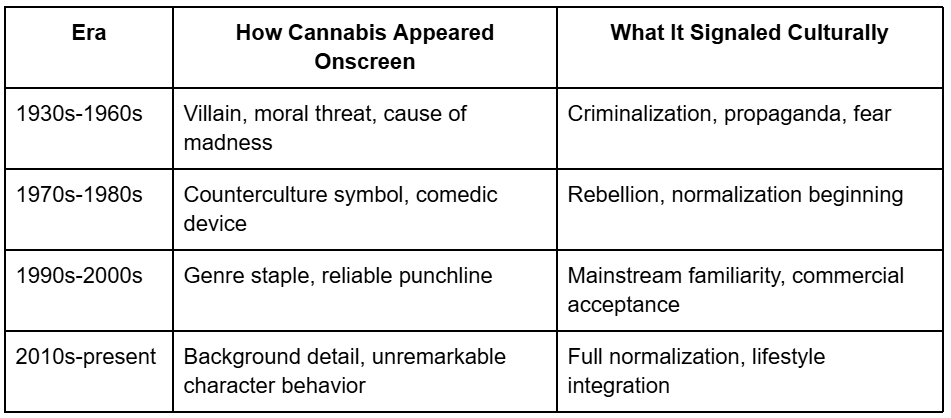
Before cannabis was a movie night companion, it was a movie villain. The 1936 propaganda film Reefer Madness - financed by a church group and initially titled Tell Your Children - depicted marijuana as a direct path to murder, madness, and moral ruin. As KQED has documented in its history of American cannabis laws, the film's release was part of a broader hysteria campaign that helped build political support for the 1937 Marihuana Tax Act, effectively criminalizing the plant and cementing its association with danger and deviance.
The film wasn't subtle. Anyone who used cannabis onscreen became a killer, a sex deviant, or a gibbering wreck within minutes of their first puff. That was the point. Cinema was functioning as policy propaganda, and it worked - not because audiences necessarily believed every claim, but because the framing was repeated often enough to become the default cultural assumption.
For the next several decades, that framing held firm. Hollywood's production code made explicit drug use off-limits for sympathetic characters, and cannabis appeared mainly as a signal of social threat. It belonged to criminals, outsiders, and countercultural deviants. That was what the culture gatekeepers needed audiences to believe, and the screen reinforced it accordingly.
The Stoner Comedy Era and What It Actually Achieved
The genre that did the most sustained work of normalization wasn't drama or documentary - it was comedy. Up in Smoke (1978) wasn't just commercially successful; it was socially significant. It treated cannabis use as ordinary, funny, and recognizably human, stripping away the threat that decades of propaganda had worked to attach to it. Audiences laughed not at cannabis users but with them, and that distinction matters enormously.
This is also the period when cannabis began its gradual transition from punchline to lifestyle product. As legalization spread across U.S. states and the range of formats grew—edibles, tinctures, vapes, and drinks—the consumer profile broadened well beyond the demographic the stoner comedies had defined. Browse the capsule collection to explore a curated selection of products suited to today’s diverse cannabis consumers. For anyone looking to find THC drink stores in their state today, the landscape looks nothing like what even a decade ago would have seemed possible, and that expansion reflects how thoroughly the cultural ground has shifted.
More films followed across the 1980s and 1990s. Friday (1995), Half Baked (1998), and eventually Pineapple Express (2008) established the stoner comedy as a reliable genre with its own grammar and its own audience. Each one made the idea of onscreen cannabis feel a little less transgressive. Gallup has tracked this arc in real time - public support for legalization in the U.S. rose from 12% in 1969 to a record 70% by 2023 - and the trajectory of that polling maps surprisingly closely onto how cannabis was being depicted on screen. Culture and public opinion were feeding each other in ways that are hard to fully untangle.
The Counterculture Reversal
The first significant crack came not from comedy but from drama. Easy Rider (1969) prominently featured cannabis use for characters that the audience was genuinely meant to identify with. Dennis Hopper's road film didn't moralize about marijuana - it simply showed two men living their lives, and that choice carried real cultural weight at a time when anti-establishment sentiment was reshaping American identity. For readers already familiar with the top movies that have celebrated cannabis culture across different eras, Easy Rider stands as one of the earliest mainstream examples of film treating the plant as something other than a social threat.
A few films mark the clearest turning points in how cannabis moved from screen villain to cultural fixture:
Reefer Madness (1936) - Financed by a church group as anti-marijuana propaganda; later became a cult comedy for cannabis advocates, its hysteria too absurd to take seriously
Easy Rider (1969) - First major Hollywood film to depict cannabis use sympathetically among protagonists, embedding it in the counterculture's rejection of mainstream authority
Up in Smoke (1978) - Cheech and Chong's debut stripped away moral panic entirely and made cannabis use funny, human, and relatable to a mainstream audience
Half Baked (1998) - Brought stoner comedy into the multiplex era, cementing cannabis as a reliable source of mainstream commercial humor rather than social commentary
Pineapple Express (2008) - Marked the genre's crossover into action-comedy, proving cannabis culture had enough mainstream goodwill to anchor a studio release
By the early 1970s, the propaganda consensus had started to collapse. Audiences recognized that Reefer Madness was camp, not cautionary. Cannabis was still illegal and still stigmatized in wide swaths of American life, but its cinematic image had begun to reflect something closer to reality - which is to say, something far less terrifying than the church groups of the 1930s had promised.
From Punchline to Protagonist
The more recent arc of cannabis in cinema is subtler but arguably more significant than what came before. Films and television from the 2010s onward largely stopped relying on cannabis as a genre identity or a comic shorthand. It became background detail - something a character might do without it defining who they were or where the story was going.
As this site's own piece on how cannabis culture has shaped modern Hollywood explores in depth, the shift has been from cannabis as a narrative centerpiece to cannabis as texture. A character in a prestige drama might roll a joint the way another character pours a glass of wine. It doesn't require explanation, doesn't trigger consequences, and isn't framed as a moral statement. That kind of casual integration is the deepest form of normalization - the point where something stops needing to be commented on because it simply belongs to the world the story inhabits.
Streaming platforms accelerated this. Shows aimed at adult audiences incorporated cannabis as unremarkable character behavior, reaching demographics far beyond the traditional stoner comedy audience. Parents, professionals, retirees - viewers who had never considered themselves part of "cannabis culture" were watching characters who used it the same way, without ceremony.
THC Drinks and the Modern Movie Night
Perhaps no product category captures the current moment better than cannabis beverages. THC drinks - seltzers, teas, infused sparkling water - represent a format specifically designed for the kind of relaxed, social context that a movie night provides. The market has responded accordingly. THC beverage sales in the U.S. topped $1.1 billion in 2024, according to research from Whitney Economics - a figure that reflects both expanding state-level legalization and a consumer base actively looking for alternatives to alcohol in social settings.
Part of what makes cannabis drinks a natural fit for film viewing comes down to format:
Discreet and shareable - a canned or bottled drink fits into any social setting without drawing attention the way smoking does
Easier to portion - clear serving sizes reduce the guesswork that edibles are known for, which matters when you want a relaxed two hours rather than an unpredictable four
More predictable onset - many THC beverages are formulated for faster, more consistent onset than traditional edibles, making them better suited to a planned activity with a defined start time
Alcohol-adjacent ritual - the act of cracking open a drink fits seamlessly into existing movie night habits without requiring any adjustment to the routine
The format fits because the ritual fits. Cannabis drinks, similar to the films they increasingly accompany, encourage a slow experience rather than quick consumption. The old propaganda had positioned cannabis as incompatible with the kind of domestic, social enjoyment that cinema represents. The current reality is almost perfectly inverted.
What the Arc Actually Means
The journey from Reefer Madness to a THC seltzer on the coffee table is, at its core, a story about cultural authority - who gets to define what something means and how those definitions shift when enough people push back. Cinema was used as a tool to demonize cannabis in the 1930s. Over the following decades, filmmakers slowly reclaimed that tool and told a different story, one that turned out to be far closer to the lived experience of millions of people.
What makes the reversal worth noting is that it wasn't driven by any single moment or movement. It happened through accumulated storytelling - hundreds of films and shows that depicted cannabis use without treating it as the central crisis. The propaganda worked by repetition. So did the normalization that followed it. Both lessons say something useful about how culture actually changes: slowly, through stories, and usually in the background of things we think we're watching for other reasons.
Movie nights have changed. The rituals around film have evolved alongside this shift. And cannabis, in whatever form it now takes, has found its place in that experience not as a villain or a punchline but as something far harder to dramatize, an ordinary part of how people choose to spend an evening together.
