
Why Ambiguous Movie Endings Keep Pulling Viewers Back
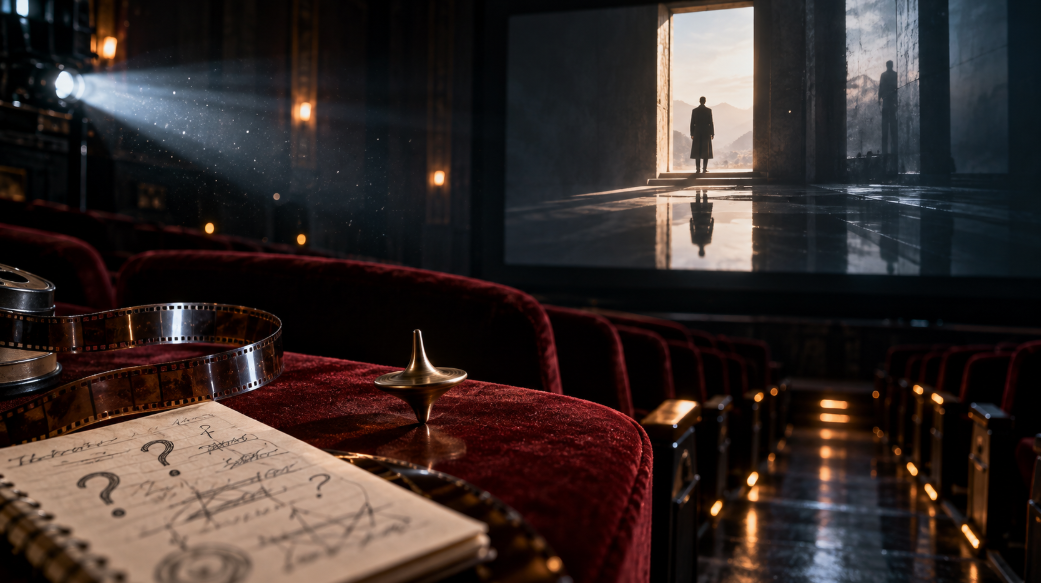
Christopher Nolan could have ended Inception (2010) with a spinning top falling over. One extra shot would have settled the question of whether Dom Cobb had returned to reality, letting the audience leave with an answer instead of a problem. Nolan cut to black before the top stopped, and viewers have been arguing about that decision ever since.
An unresolved ending gives the audience something to work on after the credits. A suspicious gesture, an unexplained object, or a missing piece of testimony can change the meaning of everything that came before it. Yet ambiguity does not automatically make a film more memorable than a happy ending. Its particular strength lies in giving viewers a reason to reconsider what they saw, often without any prospect of finding a definitive answer.
Nolan's Spinning Top Was Never Just a Trick
The final shot of Inception became famous because Nolan had already taught viewers to regard Cobb's spinning top as a test of reality. Ending the film before the result left two interpretations alive, yet Nolan later suggested that Cobb's decision to walk away from the top mattered more than whether it fell.
Speaking at Princeton University's Class Day ceremony on June 1, 2015, Nolan explained that Cobb had entered his own subjective reality with his children and no longer cared about resolving the distinction. The director used the scene to question how people separate dreams from reality.
Cobb's emotional resolution is therefore easier to identify than his physical circumstances. He chooses his children over another attempt to prove where he is. The unanswered question belongs largely to the audience.
Forty-Four Years of Doubting Two Men in the Snow
John Carpenter's The Thing (1982) takes ambiguity in a colder direction. Its surviving characters, MacReady and Childs, sit outside the burning Antarctic research station, uncertain whether either has been infected by an organism capable of imitating human beings.
Carpenter confirmed in an October 2023 interview that he knows which character is human in the final scene, yet refused to reveal the answer. He also dismissed the suggestion that lighting in the characters' eyes provides a definitive solution, despite the popularity of that interpretation.
The film's last minutes remain unsettling because certainty would immediately weaken its central fear: the inability to recognize a threat hiding inside a familiar face. Even the characters cannot establish whether they should trust one another. They have survived the destruction of the station without necessarily defeating the organism.
An Acquittal Without an Answer
Justine Triet's Anatomy of a Fall (2023) reaches a legal verdict while refusing to settle what happened to Samuel, who falls to his death outside the family home. Sandra is acquitted, but viewers never witness the fatal incident. Courtroom testimony exposes a troubled marriage without establishing whether Samuel's death resulted from murder, suicide or an accident.
Triet deliberately left the question unresolved. In a 2023 Film Comment interview, she explained that Sandra Hüller had asked whether her character was guilty or innocent. Triet said she did not know and instructed Hüller to play Sandra as innocent.
The film forces viewers to distinguish between a verdict based on available evidence and certainty about events nobody witnessed. Even Daniel, the couple's visually impaired son, must interpret incomplete information before giving testimony. His decision becomes central to the trial without revealing an objective account of his father's death.
Uncertainty Outside the Cinema Works Differently
Suspense also attracts attention in live sports, where spectators confront outcomes that have not yet been determined. Unlike a fictional mystery, a football match has an official result, and bookmakers attach prices to possible outcomes before and during play. Adults searching for betting apps download apk are generally looking for mobile access to fixtures, odds and in-play betting markets, where prices respond to new information. Decimal odds imply probabilities, although the bookmaker's margin means those figures cannot be treated as independent, perfectly calibrated forecasts. A film director can permanently withhold an answer; a football market eventually faces a result governed by its settlement rules.
Lynch Gave Viewers Clues and Made Things Worse
David Lynch's Mulholland Drive (2001) is another film that becomes difficult to dismiss after a single viewing. Its apparent identity mystery shifts toward a darker account of ambition, jealousy and fantasy, leaving viewers to reconsider earlier scenes involving Betty, Rita and the blue box.
Some DVD editions released in 2002 carried ten clues from Lynch, directing attention toward objects, dialogue and seemingly minor scenes. The list encouraged viewers to examine details ranging from a red lampshade to the significance of Club Silencio, without supplying a complete interpretation.
A conventional mystery uses clues to guide audiences toward a reveal. Lynch's film makes the act of interpretation part of the experience. Even after identifying connections between its characters and events, viewers can disagree about which scenes represent dreams, memories, or reality.
The Difference Between a Result and an Interpretation
Sports broadcasts provide an instructive contrast because viewers can disagree about tactics even after the score becomes official. A red card might change a team's defensive shape, while a substitution can alter the probabilities assigned to the remaining outcomes. Adults following live football odds on MelBet can observe markets being repriced as goals, dismissals, and other developments affect expectations. Settlement still depends on the market's specific rules: a standard full-time 1X2 football wager normally excludes extra time and penalty shootouts. An ambiguous film has no equivalent settlement mechanism, allowing viewers to agree on every visible detail while disagreeing about what those details establish.
Happy Endings Can Last, but They Close a Different Door
The Shawshank Redemption (1994) gives Andy and Red a reunion on a Mexican beach, satisfying a desire the film has built over nearly two and a half hours. Interestingly, director Frank Darabont originally intended to end the story with Red traveling toward Mexico, leaving the reunion uncertain.
Producer Liz Glotzer argued that audiences deserved to see the two men together. Darabont eventually retained the beach sequence, giving the film one of its most recognizable closing images.
That production decision illustrates why ambiguity is not inherently superior to resolution. A hopeful ending can become memorable because it completes an emotional journey, while The Thing and Inception preserve questions that the closing credits cannot settle.
