
How Camera Angles and Editing Bring Casino Scenes to Life
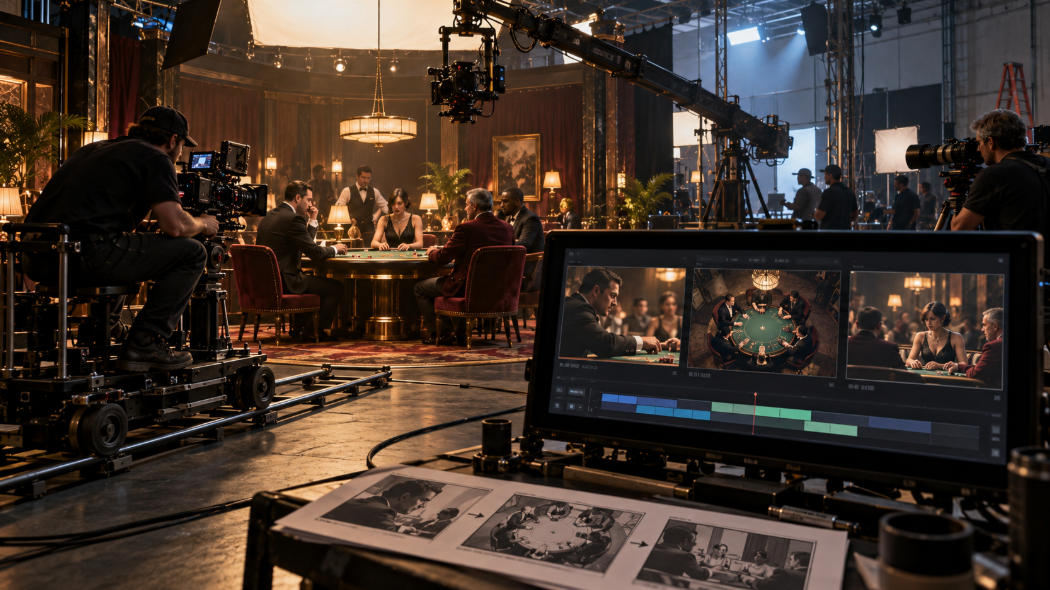
A casino floor gives filmmakers too much to look at. Dealers work beneath chandeliers and practical lights; players lean across tables; security watches from above; chips, cards and money move through crowded frames. Yet the dramatic turning point may occupy only a few centimetres of screen space: an eye movement, a card edge, a hand pausing over the felt.
The craft lies in deciding which scale matters at each moment.
A wide shot can map who occupies the room. An insert can isolate the one detail that changes the scene. A close-up can make a reaction legible before the viewer understands the mechanics behind it. Editing then determines the order in which those fragments acquire meaning.
Contemporary gambling in the province has largely moved online: toonie bet ontario, operated by Canadix Limited under an iGaming Ontario agreement, offers more than 3,000 casino games, including live-dealer tables. Films use casino spaces for a different purpose. They turn restricted knowledge, observation and misdirection into visual drama.
Casino Royale makes poker readable through faces
The poker scenes in Casino Royale faced a practical problem: a table of seated players offers little natural movement, while much of the game’s meaning depends on rules that part of the audience may not understand.
Cinematographer Phil Méheux described the solution in human rather than mathematical terms: “It’s all about looks.”
That principle shaped the coverage. Some sequences hold relatively still and let performance carry the exchange. Others move around the table. Another begins at greater distance before closing progressively on Bond and Le Chiffre.
The poker hand supplies the event; faces establish its dramatic consequence.
The production also treated editing as part of the shooting problem. With numerous players, cards, eyelines and reactions to coordinate, editor Stuart Baird was assembling material during filming. Coverage had to provide enough relational information to cut coherently, not merely enough attractive close-ups to fill a sequence.
Casino builds a hierarchy of watching
Scorsese’s Casino approaches the room from another direction. Its central visual system is surveillance.
People are constantly observing someone below or beside them: managers, pit bosses, dealers, players and security staff. Camera position turns that hierarchy into something the viewer can read.
A documented cheating sequence begins with a broader view, progressively narrows attention and eventually directs the eye beneath a participant’s clothing before a dissolve reveals the concealed mechanism. The sequence does not simply “build suspense.” It changes the viewer’s access to evidence in stages.
Photography and editing divide the work. Framing identifies where suspicion should settle; the dissolve provides a view that ordinary observation could not.
Movement serves a similar explanatory function elsewhere. In a Steadicam passage following money from a back room through the casino and toward transportation, the camera gives a financial process physical geography. Instead of treating cash flow as exposition, the sequence lets the viewer travel with it.
Ocean’s Eleven makes misdirection depend on geography
In Ocean’s Eleven, spatial comprehension becomes a prerequisite for deception.
Steven Soderbergh repeatedly stressed the need for audiences to know where characters are and where they are moving. That requirement shapes both camera movement and ensemble staging.
Steadicam is used when a conventional dolly cannot connect movements or pivots cleanly through space. In the planning scene at Reuben’s house, a 27mm lens preserves enough depth for multiple characters to occupy a readable arrangement within the same visual field.
The point is not simply elegance. A heist becomes difficult to follow if the architecture is already obscure before the film begins withholding information.
Once geography has been established, the edit can misdirect with confidence. It can leave someone out of frame, delay a reveal or shift attention to another part of the room because viewers already possess a mental map.
Editing determines the order of knowledge
Casino scenes become especially revealing when the same material is imagined in a different order.
Show the card, then the player’s reaction, and the audience interprets an emotion after learning the cause.
Hold the card back. Show the player react, cut to an opponent watching, then reveal the hand. Now the viewer has to infer what happened from behaviour before receiving confirmation.
Reaction shots are useful because they translate technical actions into social ones. Chips moving into a pot can become challenge, panic or bluff depending on who sees the gesture and how the edit answers it.
Lighting keeps complex frames readable
None of this works if faces disappear into the room.
Casino interiors are difficult photographic environments: mirrors, polished surfaces, practical bulbs, low ceilings and deep fields of competing detail. Robert Richardson’s work on Casino required adjustments to table lighting and reflective surfaces so foreground performances could remain legible against dense backgrounds.
Soderbergh faced related problems in Ocean’s Eleven, where existing practical lighting was strengthened rather than replaced with an obviously artificial scheme.
Those decisions support the camera grammar. A close-up needs readable eyes. A tracking shot needs depth without glare. An overhead view needs enough separation for bodies and tables to remain spatially distinct.
The strongest casino scenes do not derive their force from the wager itself. They work because filmmakers decide exactly what the viewer can see, what remains concealed, and when one image finally changes the meaning of everything that came before.
